
Given that V1 = 58.63 cm3/mol and V2 = 118.46 cm3/mol, what volume of mixture is formed when 750 cm3 of pure species 1 is mixed with 1500 cm3 of pure species 2 at 25oC ? What would be the volume of the mixture if an ideal solution were formed ?

a.) Find expressions for Ln g1 and Ln g2 at T and P.
b.) Show that when these expressions are combined in accord with Eq.(11.95) the given equation for GE/RT is recovered.
c.) Show that these expressions satisfy Eq.(11.96), the Gibbs/Duhem Equation.
d.) Show that (d Ln g1 / dx1)x1=1 = (d Ln g2 / dx1)x1=0 = 0.
e.) Plot GE/RT, Ln g1 and Ln g2 as calculated by the given equation for GE/RT and by the equations developed in part (a) vs. x1. Label points Ln g1∞ and Ln g2∞ and show their values.

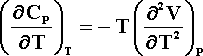

Starting from Eqn (*) in the class handout from lecture #3,
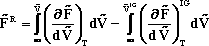
derive the equation for the Helmholtz Free Energy in Eqn (**) of the same handout.

Show all your work and explain every step of the derivation.


Please post any questions about this problem as comments on this posting.

