Please post any questions or discussion related to this problem as comments on this message. Feel free to answer other students' questions. I will check the blog M-F and once on the weekend.
Dr. B
Wednesday, March 21, 2007


HW #1, P8- Differential, Multi-Fluid Manometer - 6 pts
Please post any questions or discussion related to this problem as comments on this message. Feel free to answer other students' questions. I will check the blog M-F and once on the weekend.
Dr. B
Dr. B
Saturday, March 10, 2007
Final Exam
Please post here any questions you have about the final exam.
It has been a pleasure working with you.
Best of luck on the final exam !
Adios,
Dr. B
It has been a pleasure working with you.
Best of luck on the final exam !
Adios,
Dr. B
Friday, March 02, 2007
HW #6, P13.34 - Multiple Reaction Equilibria and Their Dependence on T and P - 22 pts
"Synthesis gas" may be produced by the catalytic reforming of methane with steam :

The only other reaction considered is :

Assume equilibrium is attained for both reactions at 1 bar and 1300 K.
a.) Would it be better to carry out the reaction at pressures above 1 bar ?
b.) Would it be better to carry out the reaction at temperatures below 1300 K ?
c.) Estimate the molar ratio of H2 to CO in the synthesis gas if the feed consists of an equimolar mixture of steam and methane,
d.) Repeat part c) for a steam to methane mole ratio in the feed of 2.0.
e.) How could the feed composition be altered to yield a lower ratio of H2 to CO in the synthesis gas than is obtained in part c.) ?
f.) Is there any danger that carbon will deposit by the reaction :

under conditions of part (c) ? Part d ? If so, how could the feed be altered to prevent carbon deposition ?

The only other reaction considered is :

Assume equilibrium is attained for both reactions at 1 bar and 1300 K.
a.) Would it be better to carry out the reaction at pressures above 1 bar ?
b.) Would it be better to carry out the reaction at temperatures below 1300 K ?
c.) Estimate the molar ratio of H2 to CO in the synthesis gas if the feed consists of an equimolar mixture of steam and methane,
d.) Repeat part c) for a steam to methane mole ratio in the feed of 2.0.
e.) How could the feed composition be altered to yield a lower ratio of H2 to CO in the synthesis gas than is obtained in part c.) ?
f.) Is there any danger that carbon will deposit by the reaction :

under conditions of part (c) ? Part d ? If so, how could the feed be altered to prevent carbon deposition ?
HW #6, P13.31 - Keq and γi for a Liquid Phase Isomerization Reaction - 10 pts
The following isomerization reaction occurs in the liquid phase :

where A and B are miscible liquids for which :
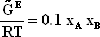
If ΔGo298 = -1,000 J/mole, what is the equilibrium composition of the mixture at 25oC ? How much error is introduced if one assumes that A and B form an ideal solution ?

where A and B are miscible liquids for which :

If ΔGo298 = -1,000 J/mole, what is the equilibrium composition of the mixture at 25oC ? How much error is introduced if one assumes that A and B form an ideal solution ?
HW #6, P13.24 - Independent Chemical Reactions and Degrees of Freedom - 4 pts
A chemically reactive system contains the following species in the gas phase: NH3, NO, NO2, O2, and H2O. Determine a complete set of independent reactions for this system. How many degrees of freedom does the system have ?
HW #6, P13.23 - Vapor Pressure of Decompositioon of NH4Cl(s) to NH3 and HCl - 12 pts
Ammonium Chloride [NH4Cl (s)] decomposes upon heating to yield a gas mixture of ammonia and hydrochloric acid. At what temperature does ammonium chloride exert a decomposition pressure of 1.5 bar ? For NH4Cl (s), ΔHof,298 = -314,430 J/mole and ΔGof,298 = -202,870 J/mole.
HW #6, P13.20 - Eeq as a Funtion of Temperature for Ammonia Synthesis from N2 and H2 - 14 pts
For the ammonia synthesis reaction :

The equilibrium conversion to ammonia is large at 300 K, but decreases rapidly with increasing T. However, reaction rates become appreciable only at higher temperatures. For a feed mixture of hydrogen and nitrogen in stoichiometric proportion :
a.) What is the equlibrium mole fraction of ammonia at 1 bar and 300 K ?
b.) At what temperature does the equilibrium mole fraction of ammonia equal 0.5 for a pressure of 1 bar ?
c.) At what temperature does the equilibrium mole fraction of ammonia equal 0.5 for a pressure of 100 bar, assuming the equilibrium mixture is an ideal gas ?
d.) At what temperature does the equilibrium mole fraction of ammonia equal 0.5 for a pressure of 100 bar, assuming the equilibrium mixture is an ideal solution of gases ?
HW #6, P13.15 - Isothermal Operation of an SO2 Catalytic Converter - 12 pts
The gas stream from a sulphur burner is composed of 15 mol% SO2, 20 mol% O2 and 65 mol% N2. This gas stream at 1 bar and 480oC enters a catalytic converter, where the SO2 is further oxidized to SO3. Assuming that the reaction reaches equilibrium, how much heat must be removed from the converter to maintain isothermal conditions ? Base your answer on 1 mole of entering gas.
HW #6, P13.13 - Effect of Pressure Change on Eeq of Reaction for the Hydrogenation of Acetaldehyde - 10 pts
The following reaction reaches equilibrium at 350oC and 3 bar:

If the system initially contains 1.5 mol H2 for each mole of acetaldehyde, what is the composition of the system at equilibrium ? What would be the effect of reducing the pressure to 1 bar ? Assume ideal gas behavior.

If the system initially contains 1.5 mol H2 for each mole of acetaldehyde, what is the composition of the system at equilibrium ? What would be the effect of reducing the pressure to 1 bar ? Assume ideal gas behavior.
HW #6, P13.5c - Problem title here - 6 pts
Consider the water-gas-shift reaction:

At high temperatures and low to moderate pressures, the reacting species form an ideal gas mixture. Application of the summability equation to Eq. (11.26) yields :

When the Gibbs energies of the elements in their standard states are set equal to zero, Gi = DGof,i for each species, and then :

At the beginning of Sec. 13.2, we noted that Eq. (14.64) is a criterion of equilibrium. Applied to the water-gas-shift reaction with the understanding that T and P are constant, this equation becomes :

Here, however, dn/dε = 0. The equilibrium criterion therefore becomes:

Once the yi are eliminated in favor of ε, Eq. (A) relates G to ε. Data for ΔGof,I for the compounds of interest are given with Ex 13.13. For a temperature of 1300 K (the reaction is unaffected by P) and for a feed of 1 mol H2 and 1 mol CO2:
a.) Determine the equilibrium value of ε by application of Eq. (B).
b.) Plot G vs. ε, indicating the location of the equilibrium value of ε determined in part (a).

At high temperatures and low to moderate pressures, the reacting species form an ideal gas mixture. Application of the summability equation to Eq. (11.26) yields :

When the Gibbs energies of the elements in their standard states are set equal to zero, Gi = DGof,i for each species, and then :

At the beginning of Sec. 13.2, we noted that Eq. (14.64) is a criterion of equilibrium. Applied to the water-gas-shift reaction with the understanding that T and P are constant, this equation becomes :

Here, however, dn/dε = 0. The equilibrium criterion therefore becomes:

Once the yi are eliminated in favor of ε, Eq. (A) relates G to ε. Data for ΔGof,I for the compounds of interest are given with Ex 13.13. For a temperature of 1300 K (the reaction is unaffected by P) and for a feed of 1 mol H2 and 1 mol CO2:
a.) Determine the equilibrium value of ε by application of Eq. (B).
b.) Plot G vs. ε, indicating the location of the equilibrium value of ε determined in part (a).
Sunday, February 18, 2007
Test #2 - SVN Chapters 11 & 12
If you have any questions related to the first test, please post them here instead of using email.
Best of luck on Tuesday !
Best of luck on Tuesday !
Thursday, February 15, 2007
HW #5, P12.3 - Fitting VLE Data Using the Margules, van Laar & Wilson Equations - 18 pts
The following is a set of VLE data for the system acetone(1) / methanlo(2) at 55oC :
P (kPa) x1 y1 P (kPa) x1 y1 P (kPa) x1 y1
68.728 0.0000 0.0000 93.206 0.3579 0.4779 100.278 0.6945 0.7124
72.278 0.0287 0.0647 95.017 0.405 0.5135 100.467 0.7327 0.7383
75.279 0.0570 0.1295 96.365 0.448 0.5512 100.999 0.7752 0.7729
77.524 0.0858 0.1848 97.646 0.5052 0.5844 101.059 0.7922 0.7876
78.951 0.1046 0.2190 98.462 0.5432 0.6174 99.877 0.9080 0.8959
82.528 0.1452 0.2694 99.811 0.6332 0.6772 99.799 0.9448 0.9336
86.762 0.2173 0.3633 99.950 0.6605 0.6926 96.885 1.0000 1.0000
90.088 0.2787 0.4184
d.) Basing calculations on the Modified Raoult's Law, find parameters for the margules Equation that provide the best fit of GE/RT to the data and prepare a Pxy Diagram that compares the experimental points with curves determined from the correlation.
e.) Repeat part (c) for the van Laar Equation.
f.) Repeat part (c) for the Wilson Equation.
HW #5, WB.1 - Pxy Diagram and Henry's Law Constants for Dichloromethane and Methanol - 14 pts
VLE data for the system dichloromethane(1) and methanol(2) at 50oC appear in the table below.
a.) Make a Pxy Diagram in Excel based on this data. No curve fit is necessary. Describe any unusual features in this diagram. Be specific and quantitative in your description.
b.) Make a fugacity or partial pressure plot (plot y1 P vs x1 and y2 P vs x1 on the same figure) in Excel. SVN Figure 12.2 is an example of such a plot.
c.) Determine the Henry's Law Constant at 50oC for each species from the partial pressure curves constructed in part b. Draw a line on each graph from part b, by hand or using Excel's drawing tools, that shows the graphical interpretation of the Henry's Law Constant for each species. (Ans.: Low-tech method (use last 2 data points and draw a line): k2 = 334 kPa/(mole 2/mol), High-tech method (fit the last 3 data points to a quadratic eqn and determine the slope as xi approaches 0): k2 = 437 kPa/(mole 2/mol) )
d.) Estimate the range of x1 values over which H1 is applicable and the range of x2 values over which H2 is applicable. Consider H values applicable as long as the error incurred is less than 5% of the partial pressure of the species.
Data :
P (kPa) x1 y1
55.55 0.000 0.000
58.79 0.042 0.093
61.76 0.097 0.174
64.59 0.189 0.265
65.66 0.292 0.324
65.76 0.349 0.349
65.59 0.415 0.367
65.15 0.493 0.386
63.86 0.632 0.418
62.36 0.720 0.438
59.03 0.835 0.484
54.92 0.893 0.537
48.41 0.945 0.620
31.10 1.000 1.000
HW #5, WB.2 - Determination of Azeotropes Using Margules and van Laar Equations - 12 pts
For each of the following systems, determine the azeotropic pressure and composition.
a.) Benzene(1) / acetonitrile(2) at 40oC. Margules parameters: A12 = 1.780, A21 = 1.055. Vapor pressures at 40oC: P1* = 29.82 kPa, P2* = 22.78 kPa.
Ans.: P ≈ 37 kPa
b.) Acetone(1) / chloroform(2) at 50oC. van Laar parameters: L12 = -0.936, L21 = -0.678. Vapor pressures at 50oC: P1* = 81.75 kPa, P2* = 69.38 kPa.
Ans.: P ≈ 61 kPa
Hints :
How can you recognize when an azeotrope exists ? Express this idea in terms of the Modified raoult's law and the Margules and van Laar Equations.
Monday, February 12, 2007
HW #5, WB.3 - Determination of Azeotropes Using the Wilson Equation - 8 pts
For the ethanol(1) / toluene(2) binary system at 1 atm, determine the azeotropic temperature and composition. The Wilson parameters for this system are given on page 474 of your textbook.
HW #5, WB.4 - Bubble Point and Dew Point Calculations Using the Wilson Equation - 22 pts
For the system methanol(1) / acetonitrile(2), the Wilson parameters are given on page 474 of your textbook and the Antoine parameters are given below.
Ln[P1*] = 16.5938 - 3644.30 / ( t + 239.76 )
Ln[P2*] = 14.7258 - 3271.24 / ( t + 241.85 )
Where P* is in kPa and t is in oC.
a.) Calculate Pbub, given x1 = 0.73 and T = 70oC
b.) Calculate Tdew, given y1 = 0.63 and P = 101.325 kPa
Ln[P1*] = 16.5938 - 3644.30 / ( t + 239.76 )
Ln[P2*] = 14.7258 - 3271.24 / ( t + 241.85 )
Where P* is in kPa and t is in oC.
a.) Calculate Pbub, given x1 = 0.73 and T = 70oC
b.) Calculate Tdew, given y1 = 0.63 and P = 101.325 kPa
HW #5, P12.22 - Multicomponent Flash Using the Wilson Equation - 20 pts
For the acetone(1) / methanol(2) / water(3) system, based on the Modified raoult's law and the Wilson Equation, make the following calculations :
a.) Bubble point temperature for P = 101.33 kPa, x1 = 0.30 and x2 = 0.40.
b.) Dew point temperature for P = 101.33 kPa, y1 = 0.30 and y2 = 0.40.
c.) PT Flash: Given P = 101.33 kPa, T = (Tbub+Tdew)/2, and z1 = 0.30 and z2 = 0.20.
a.) Bubble point temperature for P = 101.33 kPa, x1 = 0.30 and x2 = 0.40.
b.) Dew point temperature for P = 101.33 kPa, y1 = 0.30 and y2 = 0.40.
c.) PT Flash: Given P = 101.33 kPa, T = (Tbub+Tdew)/2, and z1 = 0.30 and z2 = 0.20.
HW #5, P12.27 - Volume Change of Mixing Two Liquids - 6 pts
The volume change of mixing (in cm3/mol) for the system ethanol(1) / methyl butyl ether (2) at 25oC is given by the equation:

Given that V1 = 58.63 cm3/mol and V2 = 118.46 cm3/mol, what volume of mixture is formed when 750 cm3 of pure species 1 is mixed with 1500 cm3 of pure species 2 at 25oC ? What would be the volume of the mixture if an ideal solution were formed ?

Given that V1 = 58.63 cm3/mol and V2 = 118.46 cm3/mol, what volume of mixture is formed when 750 cm3 of pure species 1 is mixed with 1500 cm3 of pure species 2 at 25oC ? What would be the volume of the mixture if an ideal solution were formed ?
Wednesday, February 07, 2007
HW #4, P11.25 - Fugacity of a Mixture: Real vs. Ideal Solution - 8 pts
For the system ethlyene(1) / propylene(2) as a gas, estimate: f1^, f2^, phi1^ and phi2^ at T = 150 degC, P = 30 bar and y1 = 0.35.
a.) Through application of Eqs.(11.59) and (11.60).
(Actually, use the SRK EOS, like in class.)
b.) Assuming that the mixture is an ideal solution.
a.) Through application of Eqs.(11.59) and (11.60).
(Actually, use the SRK EOS, like in class.)
b.) Assuming that the mixture is an ideal solution.
Subscribe to:
Posts (Atom)